Discover Kalimpong — Where the Hills Are Quiet and the Views Are Extraordinary
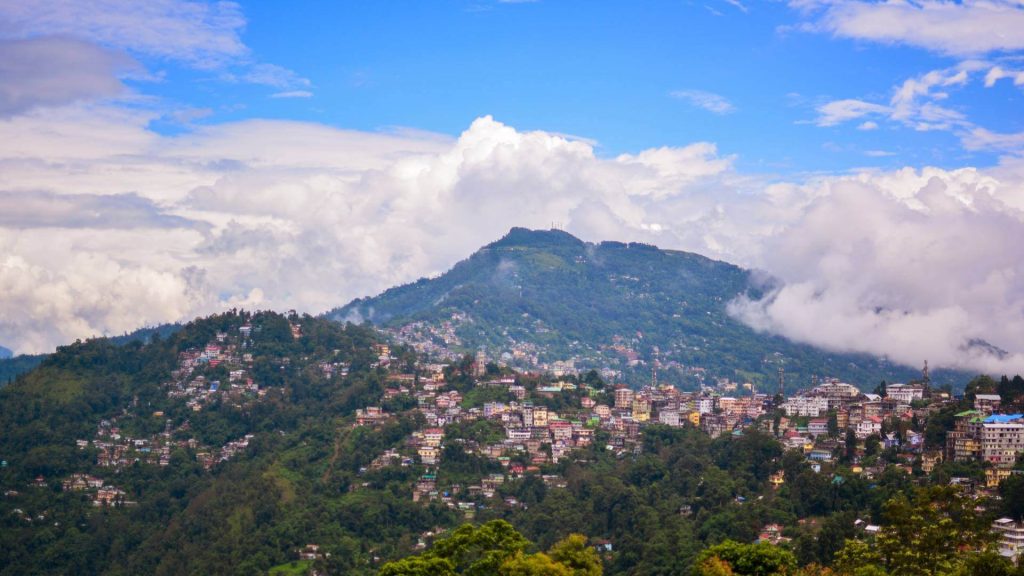
Kalimpong is one of those rare destinations that rewards every traveller who chooses it over the more obvious options. Tucked into the folds of the eastern Himalayas in West Bengal’s Kalimpong district, this compact and culturally layered hill town sits at around 1,250 metres elevation — low enough to be accessible year-round, high enough to offer sweeping views of the Teesta valley, the surrounding mountain ridges, and on clear mornings, the distant snowfields of the Kanchenjunga range.
Unlike its more famous neighbour Darjeeling, Kalimpong has not been overrun by mass tourism. The roads are quieter. The monasteries are more contemplative. The villages surrounding the town — Lava, Rishop, Lolegaon, Phikelgaon — carry a genuinely offbeat quality that is becoming increasingly rare in India’s hill destinations. A Kalimpong Tour Package from Travel Village gives you access to all of this — the town, the villages, the forests, and the ridge views — in a carefully paced itinerary that makes the most of every day.
What Makes Kalimpong Tourism Special
Kalimpong’s appeal is layered and unhurried. The town itself is a living record of its history as a trading crossroads between British India, Bhutan, and Tibet — evident in its colonial-era bungalows, Tibetan Buddhist monasteries, Presbyterian churches, and the remarkable orchid nurseries for which the town is regionally famous.
The Durpin Monastery (Zang Dhok Palri Gompa), built at the initiative of the Dalai Lama, is one of the most important Tibetan Buddhist heritage sites in West Bengal. Deolo Hill offers Kalimpong’s finest panoramic viewpoint — a maintained hilltop park from where the Teesta valley, the surrounding ranges, and the plains of North Bengal stretch out in every direction. Morgan House, a beautifully preserved colonial bungalow perched above the valley, is one of the most photographed heritage buildings in the eastern Himalayas.
Beyond the town, Kalimpong’s surrounding villages are where the real magic of a Kalimpong Sightseeing Package reveals itself. Lava’s pine forest and Buddhist monastery, Rishop’s unobstructed Kanchenjunga views, Lolegaon’s famous canopy walk through the forest canopy, and Phikelgaon’s authentic village quietude — these are experiences that no amount of advance research quite prepares you for.
Kalimpong Tour Packages from Travel Village — Built for Every Traveller
Travel Village’s Kalimpong Tour Packages are designed for the traveller who wants something genuine — not a rushed, check-box sightseeing sprint, but a real journey through a landscape that reveals itself slowly and generously. Our 5-day itinerary begins at New Jalpaiguri, New Mal, Siliguri Junction, or Jalpaiguri Road Station and moves through Lava, Rishop, Lolegaon, Phikelgaon, and Kalimpong town before dropping you back at NJP — covering every significant sightseeing point along the way.
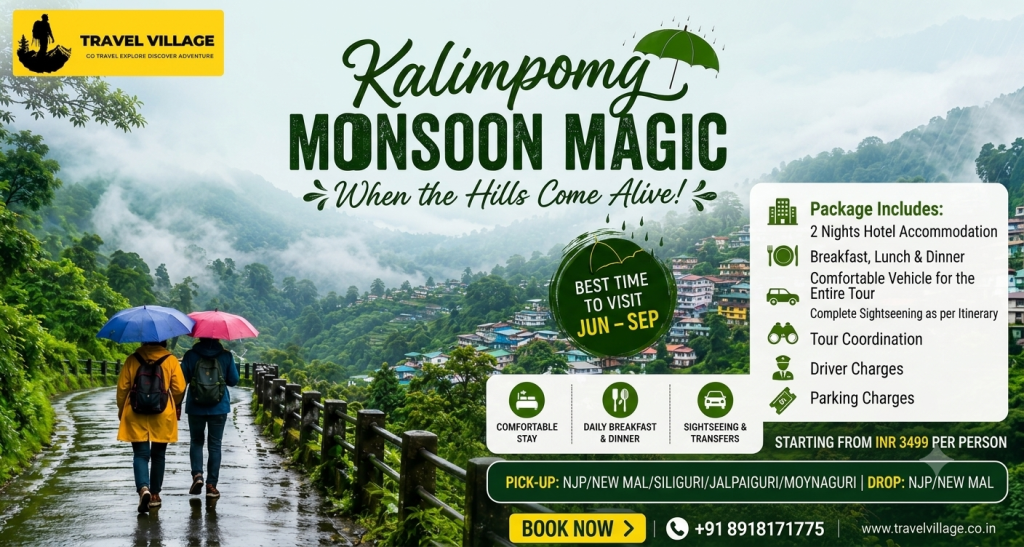
All our packages are priced at ₹1,400 per person per day, inclusive of accommodation and meals. Vehicle options range from 4-seater cars at ₹3,500 per day to 14-seater vehicles for larger groups at ₹6,500 per day. Minimum package cost starts from ₹7,000 per person for the full 5-day experience — transparent, fixed, and inclusive.
Customised Kalimpong Tour Packages are available for those who want to adjust the pace, focus more time on specific villages, or combine Kalimpong with Darjeeling or the Dooars for a broader North Bengal itinerary. Contact Travel Village to design the trip that suits you exactly.
The hills of Kalimpong are patient. They have been waiting for the right traveller — and we are here to take you there.
Kalimpong — The Hill Town That Keeps Its Secrets Beautifully
There is a particular kind of traveller who finds Kalimpong. They are not usually looking for the most famous destination on a list or the most frequently photographed viewpoint in a travel magazine. They are looking for something a little quieter, a little deeper, a little more their own. They want pine forests where the only sound is wind in the needles, monasteries where the prayer flags snap above a valley only they seem to be watching, and hill roads that wind through landscapes that have not yet been smoothed and packaged for mass consumption.
If that sounds like you, Kalimpong has been waiting.
Situated at around 1,250 metres in the Kalimpong district of West Bengal, this small hill town sits above the dramatic gorge of the Teesta River — one of the great rivers of the eastern Himalayas — at a point where the mountains begin their long descent to the plains of North Bengal. On the northern horizon, the peaks of the Kanchenjunga range are visible on clear mornings, rising white and unhurried above the layered green of the forest ridges. To the south, the plains stretch flat and hazy toward Siliguri and beyond. Kalimpong itself occupies a ridge between these two worlds — and in many ways, that in-between position defines its character perfectly.
A Town Built at the Crossroads of Cultures
Kalimpong’s history is one of the most fascinating of any small Indian hill town. For centuries, it was an important waypoint on the trade route that connected the Indian plains with Bhutan and Tibet — mule caravans carrying silk, wool, and spices moved through its market in both directions, and the town accumulated the cultural layers that such crossroads inevitably produce. Tibetan Buddhist monasteries stood alongside Scottish mission churches. Nepali farmers built terraced fields on the hillsides. Bhutanese traders established their own quarter. British planters built colonial bungalows with names like Morgan House and Himalayan Hotel.
That layered quality survives intact in Kalimpong today, and it is part of what makes the town so interesting to walk through slowly — turning a corner to find a centuries-old prayer wheel beside a Presbyterian schoolhouse, a Tibetan tangka painting gallery next to a flower nursery selling hybrid orchids, a street food stall serving traditional Gorkha fare in the shadow of a colonial clock tower.
The Monasteries and Spiritual Heritage
Kalimpong’s spiritual landscape is anchored by the Durpin Monastery, formally known as Zang Dhok Palri Gompa — a Tibetan Buddhist monastery established at the initiative of the 14th Dalai Lama in 1976 and built atop Durpin Hill with commanding views across the town and valley. The monastery houses a significant collection of rare Tibetan Buddhist texts, thangka paintings, and religious artefacts, and its prayer hall carries an atmosphere of genuine spiritual depth that is palpable even to secular visitors.
The Tharpa Choling Monastery — one of the oldest Tibetan Buddhist monasteries in the Kalimpong area — occupies a quieter spot on the hillside and is less visited than Durpin, which makes it all the more rewarding for those who seek it out. Its collection of ancient texts and its peaceful garden setting make it an excellent complement to the grander Durpin Gompa experience.
The Pedong Monastery and the scenic views along the road from Kalimpong toward the Teesta valley add further dimension to the spiritual and cultural circuit that the town and its surroundings offer.
Deolo Hill — Kalimpong’s Crown Viewpoint
Deolo Hill is the highest accessible point near Kalimpong town, and its maintained park and viewpoint represent the finest panoramic experience the district offers. At around 1,704 metres, Deolo provides a 360-degree perspective across the Teesta valley, the surrounding Himalayan ridges, the tea garden-covered foothills stretching toward Darjeeling, and the plains of North Bengal spreading southward to the horizon.
On the clearest days of winter and early spring, Kanchenjunga is fully visible from Deolo — a sight that rewards the early riser who reaches the viewpoint before the morning haze builds. The park itself is well-maintained with gardens, walking paths, and a children’s play area, making it equally suitable for a quiet morning meditation and a family outing.
The Villages Around Kalimpong — Where the Real Magic Lives
The most distinctive feature of Kalimpong tourism — the element that sets it apart from most other North Bengal hill destinations — is the ring of extraordinary villages that surround the town, each offering a different flavour of Himalayan foothill life.
Lava, at nearly 2,100 metres, is draped in pine and rhododendron forest and anchored by its Buddhist monastery and small, friendly market. It is the kind of village where the evening prayer flags catch the last light of the day and the forest settles into a silence so complete you can hear your own breathing. The Lava Pine Forest is a habitat for rare Himalayan birds, and birders regularly travel from across India to walk its trails at dawn.
Rishop, just above Lava, is even smaller and even quieter — a hamlet perched at the ridge where the eastern Himalayan views open up to reveal Kanchenjunga with a clarity that even Tiger Hill in Darjeeling cannot always match. The pine forest around Rishop is so dense and tall that the village feels held within it, protected by the trees on every side.
Lolegaon offers the unique experience of the Canopy Walk — an elevated forest trail that takes you through the pine canopy on wooden walkways, giving a perspective of the forest that is both thrilling and unexpectedly contemplative. The surrounding village is clean, quiet, and perfectly pitched for a night or two of complete forest immersion.
Phikelgaon is the least known of the four — a small village in the Kalimpong hills that is slowly being discovered by travellers who have already visited Lava and Rishop and are looking for somewhere even more remote and unhurried. It delivers on that promise entirely.
The Cactus Gardens and Nurseries — Kalimpong’s Unexpected Treasure
Kalimpong is one of India’s most important centres for floriculture and exotic plant cultivation, and its nurseries — particularly the famous Cactus Nursery — are a genuinely surprising attraction for visitors who did not expect to find rare succulents, hybrid orchids, and Himalayan flowering plants in a Himalayan hill town. The town supplies ornamental plants to markets across India, and the nursery tradition here goes back generations. Walking through the Cactus Garden is one of those Kalimpong experiences that no guidebook quite prepares you for.
When to Visit Kalimpong
Kalimpong is one of the most accessible North Bengal hill destinations year-round. The town’s elevation keeps it pleasantly cool in summer, when temperatures rarely exceed 24°C — making it an excellent escape from the heat of the plains between April and June. October through December offers the clearest skies, the finest mountain visibility, and crisp, energising air. The monsoon months bring dramatic mist and lush greenery — less suitable for viewpoints, but atmospheric and beautiful in its own way. January and February are the coldest months, with occasional frost at the higher village elevations — a magical time for those who like their hills genuinely cold.
Kalimpong will not shout at you. It will not rush you. It will simply be there — patient, generous, and quietly extraordinary — waiting for you to slow down enough to feel it.