Darjeeling Tours
Darjeeling Tourism and Tour Packages:
Plan Your Perfect Darjeeling Tour Package with Travel Village
Darjeeling has been calling travellers to its misty ridges for well over a century — and it continues to deliver the kind of travel experience that stays with you long after the journey ends. Perched in the Himalayan foothills of West Bengal at an elevation of over 2,000 metres, Darjeeling is home to some of the world’s most celebrated tea gardens, panoramic views of Kanchenjunga, a UNESCO-listed heritage railway, and a layered cultural identity that blends Tibetan Buddhist tradition, colonial British architecture, and warm Gorkha hospitality into something entirely its own.
Whether you are planning a short escape or a longer hill journey, a Darjeeling Tour Package from Travel Village gives you everything you need — comfortable accommodation, all meals, sightseeing transfers, and the local knowledge that turns a standard tour into an unforgettable experience.
Why Darjeeling Belongs on Every Traveller’s List
The appeal of Darjeeling is immediate and multi-layered. For those chasing natural beauty, it offers Tiger Hill sunrise views of Kanchenjunga that rival anything in the Himalayas. For culture seekers, Ghoom Monastery, the Peace Pagoda, and the vibrant bazaars offer hours of discovery. For tea lovers, Happy Valley Tea Garden and the dozens of estates that carpet the hillsides produce some of the finest tea leaves in the world — and you can taste them fresh at the source.
Families find Darjeeling particularly rewarding. The Padmaja Naidu Himalayan Zoological Park is home to rare species including the snow leopard, red panda, and Siberian tiger — a genuine wildlife experience at high altitude. The UNESCO-listed Darjeeling Himalayan Railway (Toy Train) is an experience that delights travellers of every age, chugging through the hillside with views that shift from forest to valley to snowline with every curve.
Darjeeling Tour Package from Kolkata — Your Gateway to the Hills
For travellers from Kolkata, Darjeeling is one of the most accessible mountain destinations in India. An overnight train from Kolkata to New Jalpaiguri (NJP) or New Mal Junction puts you at the foot of the hills by morning, ready to begin your ascent. Our Darjeeling Tour Package from Kolkata is designed around this convenience — picking you up at NJP and taking you seamlessly through a curated itinerary that wastes none of your time and misses none of the best sights.
Best Darjeeling Tour Package for Every Budget
Travel Village offers transparent, value-driven packages for all group sizes and budgets. Our packages are structured at ₹1,500 per person per day, inclusive of meals and accommodation — making us one of the most honest and affordable options for anyone looking for a cheap Darjeeling Tour Package that does not sacrifice comfort or experience.
Vehicle options cover every group size — from 4-seater cars at ₹3,500 per day to 14-seater vehicles at ₹6,500 per day — ensuring that the Darjeeling Tour Package cost scales fairly whether you are travelling as a couple, a family, or a larger group.
Darjeeling Tour Package for Family — Safe, Comfortable, Complete
Darjeeling is one of the safest and most family-friendly hill destinations in India. Our Darjeeling Tour Package for Family itineraries are designed with younger travellers in mind — pacing the sightseeing comfortably, choosing family-appropriate accommodation, and ensuring that every day includes something for every age group. From the wonder of the Toy Train to the thrill of a ropeway ride over the tea gardens, Darjeeling delivers family memories that children carry for years.
Our 3 Nights 4 Days Darjeeling Tour Package is the most popular format — giving enough time to cover Tiger Hill, Batasia Loop, Ghoom Monastery, Happy Valley Tea Garden, Rock Garden, and the Darjeeling town market without feeling rushed, and with one full day available for personalised exploration.
Customised packages are available for those who want to extend their stay, combine Darjeeling with Kalimpong or the Dooars, or design a route that fits their specific interests. Contact Travel Village today and let the hills welcome you on your own terms.
Darjeeling Tourism:Darjeeling - The Hill Station That Never Loses Its Magic
There are places in the world that earn their reputation honestly — destinations where the reality matches the promise, where the view from the viewpoint is as extraordinary as the photograph suggested, and where the atmosphere of a place settles around you like something you did not know you were looking for. Darjeeling is one of those places. It has been drawing travellers, writers, tea merchants, mountaineers, and wanderers to its hillsides for nearly two centuries, and the reasons remain as compelling in 2026 as they were when the first British planters carved their bungalows into the ridge.
Darjeeling sits at an elevation of approximately 2,042 metres in the Darjeeling Himalayan hill region of West Bengal, flanked by the state of Sikkim to the north, Nepal to the west, and the broad plains of North Bengal far below to the south. The surrounding landscape — a patchwork of tea estates, dense forest, deep ravines, river valleys, and bare ridgelines — is one of the most visually varied of any Indian hill station. And presiding over it all, visible on clear mornings from nearly every elevated point in the region, is the Kanchenjunga massif — the third-highest mountain on earth, glowing white and pink and gold at sunrise in a spectacle that has reduced hardened travellers to silence for generations.
The Tea Gardens of Darjeeling — A Living Landscape
No introduction to Darjeeling tourism is complete without the tea. The Darjeeling tea gardens — more than 80 of them, covering the hillsides in a precise, beautiful geometry of cultivated bushes — produce some of the most prized tea in the world. The Darjeeling first flush, harvested in spring, is sought by tea connoisseurs globally and commands prices that few agricultural products anywhere can match.
For visitors, the tea gardens are not simply a commodity — they are a landscape experience. Walking through the rows of Happy Valley Tea Garden, watching the women pluck leaves with the dexterity of long practice, seeing the processing facility where fresh green leaf is transformed into the amber liquid that has made Darjeeling’s name — this is a genuine encounter with a living industry and a centuries-old culture that has shaped this hillside as much as the geography beneath it.
The best tea gardens for visitor access include Happy Valley, Glenburn, Makaibari, and Castleton — each offering a slightly different experience of what it means for tea to be grown, processed, and brewed in the hills where it was born.
Sunrise at Tiger Hill — The Moment Darjeeling Is Famous For
Tiger Hill stands at 2,590 metres — the highest point near Darjeeling town — and the sunrise viewed from its summit is one of the defining travel experiences of the Indian subcontinent. Travellers set their alarms for 3:30 or 4 AM, pile into jeeps for the pre-dawn drive up winding hill roads, and gather at the summit viewpoint as the dark sky lightens from black to purple to deep blue.
Then, as the first light reaches the snowline, Kanchenjunga ignites. The colour moves from pale gold to deep orange to brilliant white in the space of minutes, and on the clearest mornings, the distant profiles of Makalu and Mount Everest are visible to the left — the highest points on earth, visible from a hilltop in West Bengal. It is a moment that demands silence and receives it.
The Tiger Hill sunrise is not guaranteed — cloud cover and monsoon season frequently obscure the view. But when it delivers, it delivers completely. Every traveller who has witnessed it will tell you the same thing: the early alarm was worth it.
The Darjeeling Himalayan Railway — A Journey Through Time
The Darjeeling Himalayan Railway — affectionately known as the Toy Train — is one of only a handful of mountain railways in the world to hold UNESCO World Heritage status, a recognition it earned in 1999 and has held with quiet dignity ever since. The railway was built between 1879 and 1881, and its steam locomotives still operate on certain routes today — living heritage rolling through the same hillsides they have served for nearly 150 years.
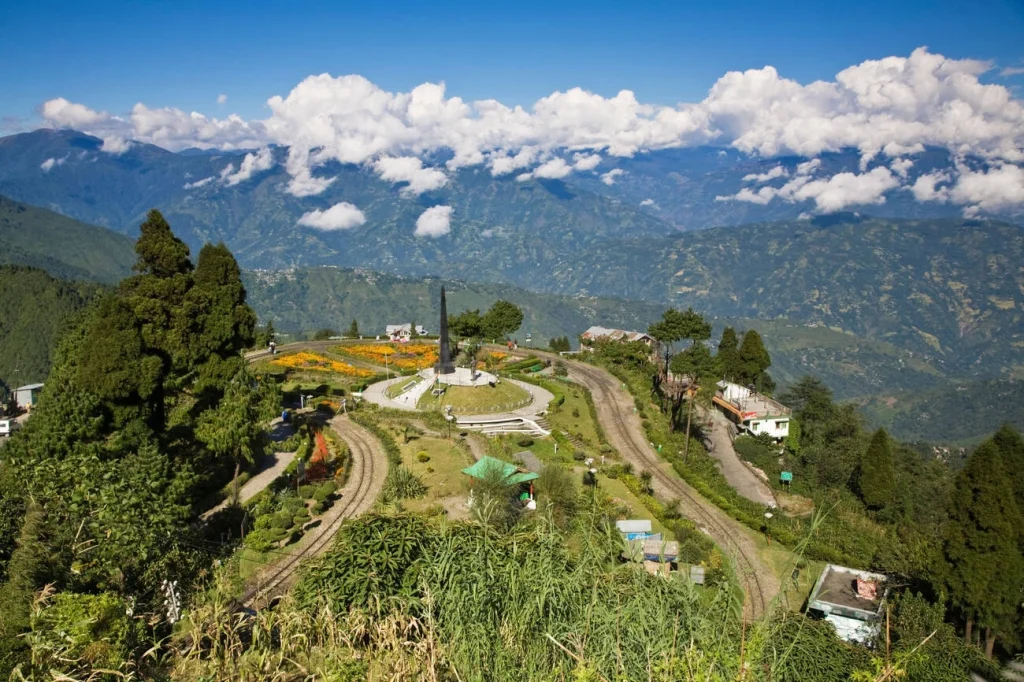
The most celebrated section of the railway passes through Batasia Loop — a spiral loop where the train makes a full 360-degree turn to manage the steep gradient, passing through beautifully landscaped gardens and a Gorkha War Memorial before continuing its descent. The views from the train — of the valley below, the tea gardens, and the mountains beyond — are among the finest train journey vistas in Asia.
Culture, Faith, and Heritage in the Hills
Darjeeling’s cultural identity is a rich weave of traditions, faiths, and histories. The town’s Tibetan Buddhist heritage is most visible in its monasteries — Ghoom Monastery (Yiga Choeling), the oldest in the region, houses a 15-foot Maitreya Buddha and holds prayer ceremonies that visitors are welcome to observe. The Bhutia Busty Gompa, relocated from its original Sikkim site in the 19th century, is another important spiritual landmark.
The Japanese Peace Pagoda on the edge of the town offers a different spiritual tradition — a brilliant white stupa visible from across the hillside, surrounded by gardens and maintained by Japanese Buddhist monks. Observatory Hill, where the Mahakal Temple stands beneath prayer flags amid ancient trees, is sacred to both Hindu and Buddhist devotees — a peaceful and deeply atmospheric place to spend a quiet morning.
The town market and Mall Road carry the living culture of Darjeeling’s daily life — local food stalls serving momos, thukpa, and the inevitable cup of tea; shops selling Tibetan handicrafts, silver jewellery, and handwoven textiles; the easy, unhurried pace of a hill town that knows it is exactly where it wants to be.
When to Visit Darjeeling
Darjeeling is a year-round destination, with each season offering a distinctly different experience. March to May brings the first flush of spring — rhododendrons blooming red and pink across the hillsides, clear skies for Kanchenjunga views, and the best tea harvest of the year. October to December offers crisp, clear air, vivid blue skies, and the finest mountain visibility of any season. Winter brings occasional snow to the upper reaches and a quiet magic to the town when the tourist crowds thin. The monsoon months of June to September bring dramatic mist and rainfall — less ideal for viewpoints but extraordinarily atmospheric for those who love the hills in their most elemental mood.
Darjeeling is, ultimately, a place that gives generously to every kind of traveller. Come for the sunrise, stay for the tea, and leave with the mountains in your memory — waiting to call you back.
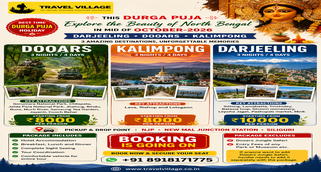
Durga Puja Tour Package 2026 – Celebrate Durga Puja Amidst the Natural Beauty of Dooars, Kalimpong & Darjeeling